
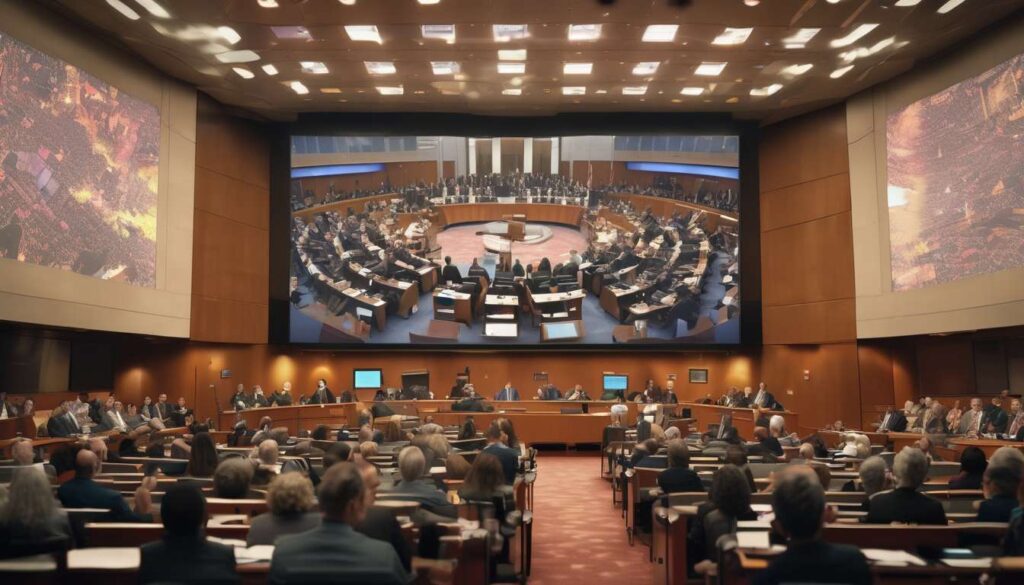
Driving home after a city council meeting, we found ourselves in a small diner where two strangers argued about who should police adult content platforms.
The debate shifted from moral outrage to practical questions:
- age verification
- platform liability
- economic impact
The man argued for stricter regulation to protect children.
The woman warned that heavy-handed rules would push creators underground and erode privacy.
That exchange crystallized what we had seen in reports and hearings:
- policymakers, platforms, creators, parents, and civil-rights advocates are often speaking past one another.
As we gather perspectives for this article, we aim to move beyond soundbites and illuminate the trade-offs at stake:
- Freedom of expression
- Child protection
- Public safety
- Digital livelihoods
Our goal is not to pick winners but to map the policy terrain so readers can understand the technical constraints, legal frameworks, and human consequences shaping this contentious debate.
Regulatory Landscape
Who sets the rules
- National and subnational governments enact laws that directly regulate adult content (age restrictions, obscenity, record-keeping, payment rules, taxation, advertising limits).
- Industry bodies and trade associations issue standards and best practices (e.g., age-verification frameworks, safety guidelines, payment-processor codes of conduct).
- Platforms create and enforce their own terms of service, community guidelines, payment eligibility rules, and technical controls.
- Civil-society organizations and advocacy groups influence norms, call out harms, and push for transparency and rights protections.
What rules apply (key areas)
- Age verification and access control — often mandated by law (to prevent minors from accessing adult content) but implemented with varying rigor and technologies.
- Content classification and prohibitions — definitions of illegal content (child sexual exploitation, non-consensual material, extreme obscenity) are set by statute and reflected in platform policies.
- Platform liability and intermediary status — laws determine whether platforms are treated as neutral intermediaries (limited liability) or as publishers with active duties (stricter obligations to monitor/remove content).
- Monetization, payments, and taxation — rules governing payment processing eligibility, chargebacks, service bans, and tax reporting affect creators’ income flows.
- Privacy, data retention, and record-keeping — requirements for storing age-verification records or user data vary and raise privacy and security concerns.
- Advertising and cross-border commerce — restrictions on advertising adult services and varying rules for international transactions complicate business models.
Where enforcement is inconsistent (pain points and gaps)
- Uneven age-verification implementation — laws may demand age checks, but platforms adopt different technical standards (self-attestation, third-party verification, or none), creating gaps that expose minors and frustrate compliant creators.
- Patchwork intermediary liability — some jurisdictions protect platforms with safe-harbor rules, while others impose proactive duties; global platforms must reconcile conflicting obligations, often defaulting to the strictest rule or broad takedowns.
- Opaque platform enforcement — inconsistent application of TOS (sudden bans, unclear appeals) leaves creators uncertain about permitted content and exposes them to deplatforming risk.
- Payment and banking exclusion — financial institutions and processors apply uneven criteria: some refuse any adult-related transactions, others permit limited activity, creating unpredictable monetization pathways.
- Cross-border legal conflicts — content lawful in one jurisdiction may be illegal in another; platforms typically apply global rules unevenly or geoblock, harming creators who operate legally in their home jurisdictions.
- Record-keeping vs. privacy trade-offs — requirements to retain identification or sexual-records clash with privacy protections and raise security risks; enforcement varies by region.
Why this matters for creators and communities
- Economic stability — inconsistent payment and tax rules directly affect creators’ income and planning.
- Sense of belonging and fairness — opaque or arbitrary moderation undermines trust and can exclude contributors unfairly.
- Safety and compliance — unclear age-verification and content rules increase risk for both creators and users (legal exposure, abusive interactions, exploitation).
- Innovation and business viability — regulatory uncertainty discourages new platforms or features that could improve safety and creator revenue.
Where coordination would help (recommended focus areas)
- Harmonize minimum age-verification standards — agree on interoperable technical and privacy-preserving methods to reduce gaps while protecting data.
- Clarify intermediary obligations — promote clear, proportionate duties that balance safety with due process and enable consistent global platform practices.
- Standardize transparent enforcement and appeals — require clear notice, reasons for actions, and a functioning appeal process to reduce arbitrary takedowns.
- Create payment-access pathways — develop industry agreements or regulated carve-outs for adult-content commerce with anti-fraud and AML safeguards.
- Align record-keeping with privacy safeguards — mandate minimal necessary retention, strong security, and limited government access to reduce misuse risks.
- Foster cross-stakeholder governance — include creators, platforms, payment providers, regulators, and civil-society groups in creating shared norms and compliance roadmaps.
Immediate mapping steps you can take
- Inventory applicable national laws across jurisdictions where creators, users, and servers are located.
- Collect platform policies and enforcement histories (TOS, suspension rates, appeals outcomes).
- Map payment-processor and banking restrictions relevant to your community.
- Identify enforcement inconsistencies by comparing legal obligations to platform practice.
- Prioritize gaps with highest creator impact (payments, age-verification failures, arbitrary bans) and target those for coordinated policy or technical fixes.
If you want, I can:
- Produce a template checklist to inventory laws, platform rules, and payment restrictions for a given jurisdiction.
- Draft a short policy brief aimed at platforms and regulators recommending the six coordination steps above.
- Map out a prioritized action plan for your community based on the immediate mapping steps. Which would you like first?
Age Verification Challenges
Many jurisdictions require reliable age checks to keep minors off adult sites.
However, implementing those checks raises technical, legal, and privacy trade-offs that remain unresolved. The core shared challenge is verifying users’ ages without alienating community members or exposing sensitive data.
Goals for age verification systems:
- Accuracy: verify age with low false-positives and false-negatives.
- Inclusivity: accommodate users who lack standard ID documents or face verification barriers.
- Privacy preservation: minimize data collection and exposure (e.g., credential hashing, third-party attestations, limited retention).
Preferred technical and privacy-preserving methods:
- Credential hashing or cryptographic proofs that confirm age without revealing identity.
- Trusted third-party attestations that vouch for age claims while keeping platforms from storing raw IDs.
- Minimal data retention policies and strong access controls to reduce leakage risk.
Equity and access considerations:
- Recognize barriers for marginalized users who may not have typical IDs.
- Advocate alternatives that preserve dignity and access (for example, community-based attestations or low-friction attesters).
- Design appeals processes and accommodations so legitimate users aren’t locked out.
Economic and legal trade-offs:
- Any verification approach affects platform liability and creator monetization.
- Balance safety measures with creators’ livelihoods to avoid undue harm to legitimate content and income.
- Favor transparent policies so stakeholders understand obligations and consequences.
Governance and interoperability:
- Promote clear appeals processes and transparent decision-making.
- Develop interoperable standards that communities and platforms can trust.
- Encourage collaboration among regulators, platforms, creators, and advocates to build practical, equitable frameworks.
Conclusion:
By prioritizing accuracy, inclusivity, privacy, transparency, and cross-stakeholder collaboration, we can build age verification frameworks that protect minors while keeping creators and users connected.
Platform Liability Debates
Purpose and scope: who bears legal responsibility for third-party adult content
Key point: Platforms, creators, and users share responsibility, but legal liability depends on the platform’s role—passive host versus active facilitator—and on whether the platform acted negligently or deliberately. Clear allocation of responsibility should inform moderation, liability protections, and enforcement.
Elements to consider:
- Platform role (hosting, recommending, promoting, monetizing).
- Platform knowledge (actual knowledge of illegal content vs. plausible ignorance).
- Platform conduct (reasonable steps taken to prevent, detect, and remove unlawful material).
Age verification and technical measures: reduce risk and demonstrate good-faith compliance
Key point: Strong, transparent age-verification standards should be required to reduce minors’ exposure and to evidence platforms’ good-faith efforts. Technical measures mitigate risk but do not automatically absolve liability where negligence or deliberate facilitation exists.
Recommended measures:
- Clear, industry-standard age-verification protocols that balance privacy and effectiveness.
- Audit trails and documentation proving implementation and periodic effectiveness testing.
- Greater scrutiny where platforms enable monetized adult interactions or direct messaging.
Moderation, reporting, and takedown practices: align incentives with community norms
Key point: Transparent, timely, and consistently applied moderation processes align platform incentives with user safety and community expectations.
Standards for platforms:
- Publish clear content policies and enforcement criteria.
- Provide accessible, fast reporting and escalation channels.
- Implement timely takedowns for unlawful content and publish transparency reports on actions and outcomes.
- Maintain accountable creator-monetization rules that deter abuse without arbitrary income cuts.
Calibrated liability shields: protect good-faith actors, preserve remedies
Key point: Liability protections should incentivize proactive, transparent behavior while preserving remedies for harm when platforms enable or ignore violations.
Framework principles:
- Platforms that implement and document robust prevention, detection, and remediation measures qualify for stronger protections.
- Platforms that knowingly facilitate illegal activity, deliberately bypass safeguards, or act with gross negligence should face liability.
- Transparency requirements (reports, audits, notice-and-takedown records) should be tied to the scope of liability protection.
Monetization and creator accountability: deter abuse while protecting economic opportunity
Key point: Policies must prevent monetized abuse (exploitation, trafficking, underage content) without arbitrarily penalizing legitimate creators.
Policy components:
- Clear monetization eligibility rules and periodic re-verification.
- Proportionate penalties that escalate with severity and repeat offenses.
- Appeal and remediation pathways for creators to contest actions and regain eligibility when appropriate.
Collaborative governance: users, creators, platforms, and regulators working together
Key point: Durable policy requires cooperative, multi-stakeholder governance that balances safety, free expression, and creator livelihoods.
Actions to pursue:
- Establish multi-stakeholder bodies to set standards and review emerging harms.
- Promote shared technical standards (age verification, reporting metadata, audit formats).
- Encourage regulatory frameworks that recognize calibrated liability shields tied to demonstrable safeguards.
Conclusion: a balanced, transparent framework
Key point: The appropriate approach combines strong technical safeguards, transparent moderation and monetization policies, and calibrated liability protections. This balances safety and free expression, protects creators’ economic opportunities, and preserves remedies when platforms enable or ignore unlawful activity—while making clear who is responsible and why.
Privacy and Surveillance Risks
Many users and creators face heightened privacy and surveillance risks on adult platforms.
We must examine how data collection, retention, sharing, and inference practices can expose sensitive sexual information and enable harassment, blackmail, or discrimination.
Invasive tracking and poorly secured databases make people vulnerable, especially when platform liability is unclear and legal protections lag.
Systems should limit data to what’s strictly necessary, anonymize identifiers, and enforce short retention windows so intimate details aren’t weaponized.
Age verification needs careful design:
- It should confirm age without creating permanent, linkable profiles that reveal participation in adult spaces.
- It should avoid centralized storage of identifying documents when possible and use privacy-preserving techniques (e.g., zero-knowledge proofs or tokenized attestations).
We’re calling for:
- Transparent audit logs that record who accessed sensitive data and why.
- User-centered consent practices that are clear, granular, and revocable.
- Strong access controls to prevent moderators, advertisers, or third parties from exploiting data.
In solidarity with creators, we support policies that protect privacy while preserving creator monetization options so people don’t have to trade safety for livelihoods.
We will push for clear rules that balance safety, dignity, and accountability.
Economic Effects on Creators
Many creators depend on adult platforms for income, so we must assess how policy changes, payment restrictions, and algorithmic shifts can reduce earnings or force risky migration to less safe spaces.
We’re concerned that stricter age verification requirements, while protecting minors, can raise compliance costs and delay payouts, squeezing creator monetization.
When platforms face heightened platform liability, they may preemptively demonetize or remove content, leaving creators with little recourse and unstable revenue.
We want policies that recognize creators as community members, not collateral damage.
- Design age verification that’s privacy-preserving and affordable.
- Clarify liability so platforms can’t reflexively cut income streams.
- Support diverse monetization channels so creators aren’t dependent on a single algorithm.
We’ll advocate for transitional supports, transparent takedown processes, and payment rails that work for marginal creators.
By centering creators’ livelihoods, we’ll keep our community resilient while meeting legitimate safety and legal goals.
Free Expression Considerations
We must balance protecting vulnerable people and upholding creators’ rights to free expression so policy doesn’t unintentionally silence lawful, consensual content.
We recognize that many creators rely on platforms not just for income but for community and self-expression, and we want rules that treat them with dignity.
When debating age verification, we insist measures be accurate without being invasive or exclusionary; solutions should protect minors while preserving adults’ ability to participate.
We worry that broad notions of platform liability could push companies to over-censor to avoid risk, narrowing the spaces where creators can speak and connect.
Policy should target demonstrated harms, not hypothetical ones, and should include clear appeals and transparency so creators feel supported.
Thoughtful rules must consider creator monetization mechanics, ensuring fair access to revenue streams and predictable enforcement.
By centering belonging and rights, we can craft policies that protect vulnerable people while sustaining vibrant, lawful creator communities.
Enforcement Practicalities
Enforcing rules at scale requires clear procedures, reliable tools, and consistent staff training so we can act swiftly and fairly while minimizing errors and disruption.
We need practical workflows that balance speed with review quality, and we welcome team members who share that mission.
Our approach must integrate robust age verification without creating exclusionary barriers; we’ll favor privacy-preserving methods that respect users while meeting legal demands.
We’ll keep platform liability front of mind, documenting decisions and escalation paths so outcomes are defensible and transparent.
That means building logs, audit trails, and appeal mechanisms that let community members feel heard and protected.
We’ll also consider how enforcement touches creator monetization, ensuring takedowns or restrictions are proportionate and accompanied by clear explanations and remediation paths so creators don’t feel arbitrarily punished.
We’re committed to continuous learning: measuring accuracy, adjusting tooling, and training staff to handle nuance.
In doing so, we’ll create a safer, fairer environment where everyone feels they belong and can participate responsibly.
Stakeholder Perspectives
We’ll center the conversation on the perspectives of key stakeholders—creators, consumers, regulators, civil-society groups, and advertisers—to ensure policy choices reflect real needs and trade-offs.
Creators:
- Creators urge fair monetization and clear rules so their work is valued and safe.
Consumers:
- Consumers want privacy, reliable age verification, and respectful community norms that let them participate without stigma.
Regulators:
- Regulators push for enforceable standards and clarity on platform liability to protect minors and uphold the law.
Civil-society groups:
- Civil-society groups demand rights-respecting approaches that address power imbalances and support survivors.
Advertisers:
- Advertisers seek brand safety and transparent content labeling.
We’ll weigh these views together, recognizing shared goals: safety, dignity, and economic opportunity.
Policy approach:
- Advocate policy designs that balance harm prevention with free expression and viable livelihoods.
- Use proportional rules, technical safeguards, and accountable oversight.
- Center voices and trade-offs to craft solutions that feel inclusive, practical, and just for everyone involved.
What historical events or cultural shifts led to the current focus on regulating adult content platforms?
We’ve seen moral panics, technological leaps, and shifting family norms drive scrutiny of sexual content.
Historical movements have shaped public attitudes:
- Censorship movements and the sexual revolution changed laws and norms.
- The internet’s explosion made distribution easy and widespread.
High-profile events intensified calls for oversight:
- Scandals and trafficking revelations raised awareness and urgency.
- Data-privacy breaches highlighted new risks around content and user information.
Current drivers of policy and platform responses:
- Advocacy from survivors and parents demanding protection and redress.
- Political shifts that influence regulation and enforcement priorities.
- A push for platform accountability that balances freedom, safety, and community well-being.
How do international human rights laws influence national policies on adult content, and are there examples where they have overridden domestic regulations?
International human rights law shapes national rules on adult content by emphasizing privacy, freedom of expression, and non-discrimination. These principles push states toward regulatory approaches that respect individual rights and protect performers, and they form the basis for advocacy and compliance efforts.
Courts and treaty bodies can compel changes: for example, the European Court of Human Rights and other international bodies have in some cases required states to relax overly broad restrictions or to strengthen protections for performers, producing concrete effects on member states’ laws and practices.
There are important limits to this influence. Sovereignty, the diversity of domestic legal systems, and vague or context-dependent human-rights standards mean that outright overrides of national rules are uncommon. Nonetheless, when international decisions or recommendations do take hold, they can have significant, precedent-setting impact.
What technological innovations (beyond age verification) are being explored to balance user safety and freedom on adult platforms?
We’re exploring technologies beyond age checks that protect users while preserving freedom.
Privacy-preserving content moderation:
- On-device AI that classifies and filters harmful content without sending raw data to servers.
- Federated learning to improve models across devices while keeping user data local.
Encrypted identity-lite attestations:
- Use cryptographic proofs to confirm properties (e.g., adult vs. minor) without revealing full identity.
- Minimize data shared with services while supporting trust decisions.
Granular consent dashboards:
- Give users fine-grained control over what is shared and why.
- Make consent revocable and transparent, with clear explanations of consequences.
Differential privacy for analytics:
- Aggregate usage insights with mathematical privacy guarantees to inform safety measures without exposing individuals.
User-driven content labeling with reputation systems:
- Let users tag content and surface community signals.
- Use reputation scores to weigh labels and reduce abuse.
Real-time safety prompts (pilot):
- Contextual nudges that warn or guide users during risky interactions without heavy-handed blocking.
Trust networks and community norms (pilot):
- Let communities define and enforce norms, enabling decentralized moderation aligned with local values.
Overall goal:
- Combine these tools so platforms can stay safe together without sacrificing autonomy, emphasizing privacy, user control, and community-driven governance.
Conclusion
You’ve seen how the debate about adult content platforms pulls together regulation, technology and rights.
Whatever path policymakers choose, they’ll need:
- Age-verification tools that actually work without creating surveillance risks.
- Clear liability rules that don’t crush creators.
- Realistic enforcement that can be implemented fairly and effectively.
Balancing safety, privacy, and economic livelihoods will require meaningful input from:
- Platforms
- Creators
- Child-safety groups
- Civil-rights advocates
If you care about online freedoms or protecting minors, stay engaged and demand nuanced, evidence-based solutions.